
Chiropractor or Physical Therapy After Injury?
- Justin Quisberg
- 1 day ago
- 5 min read

After a crash, a fall, or a sudden twist that leaves your neck or back locked up, one question comes up fast: chiropractor or physical therapy? It is a fair question, especially when pain makes simple things harder - turning your head, getting out of bed, sitting through work, or driving across San Antonio without wincing.
The right choice depends on what was injured, how your body is moving, and what kind of recovery you need. For many people, this is not about picking a “better” option in the abstract. It is about getting the right kind of care at the right time so pain does not settle in and mobility does not keep getting worse.
Chiropractor or Physical Therapy: What Is the Difference?
Chiropractic care focuses on how the spine, joints, and nervous system are functioning together. When an accident or strain causes spinal misalignment, joint restriction, or muscle guarding, a chiropractor works to restore motion, reduce pressure, and help the body move more normally again. That often includes spinal adjustments, cervical mobility work, soft tissue treatment, and targeted care for back pain, neck pain, and whiplash.
Physical therapy is centered more on movement training and rehabilitation. A physical therapist typically helps rebuild strength, improve flexibility, retrain balance, and restore function after injury or surgery. Treatment often includes guided exercises, stretching, mobility drills, and progressive rehab plans.
Both approaches can be valuable. The difference is usually in where the treatment starts. Chiropractic care often begins by addressing joint restriction, spinal mechanics, and pain patterns that are interfering with movement. Physical therapy often begins with structured rehab to strengthen and retrain the body over time.
When a Chiropractor Makes More Sense
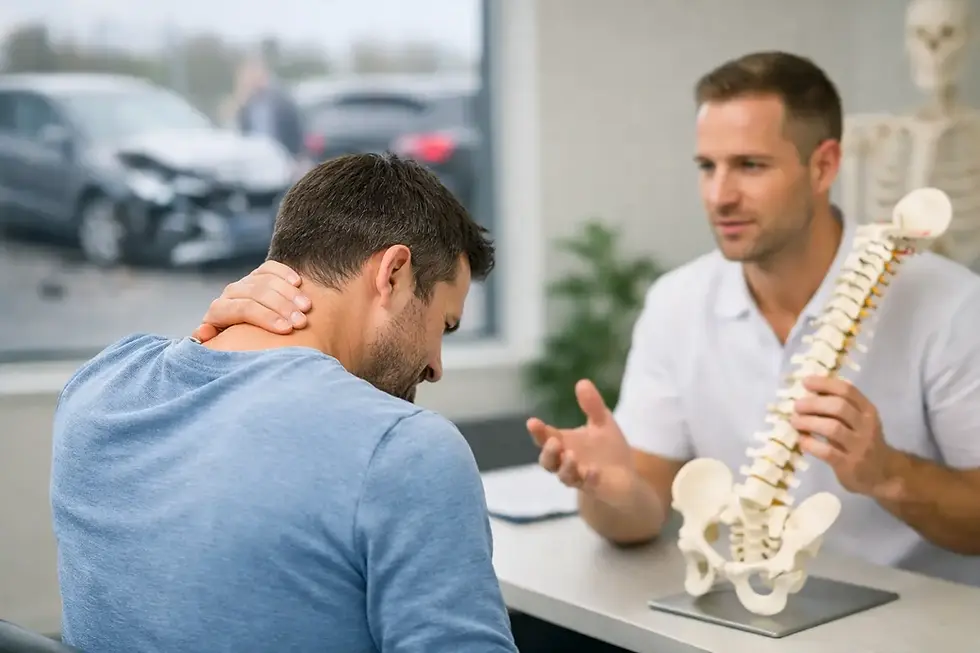
If your pain started after a car accident, chiropractic care is often a strong first step. That is especially true with whiplash, neck stiffness, headaches after impact, mid-back pain, lower back pain, reduced range of motion, or a feeling that your body is just “off” since the injury.
These problems are common after crashes because the force of impact can disrupt spinal alignment, strain soft tissue, and irritate nerves even when no bones are broken. You may still be able to walk, work, or push through the day, but your body is compensating. That compensation can create more pain, more tightness, and more inflammation over time.
A chiropractor is trained to identify these mechanical problems and treat them directly. If your neck does not rotate well, your shoulders feel uneven, your back keeps tightening up, or headaches started after the accident, chiropractic treatment may address the root issue more directly than a general exercise plan alone.
This is also why many accident patients want care quickly. Early treatment can help reduce joint restriction and muscle guarding before those patterns become harder to correct.
When Physical Therapy May Be the Better Fit
Physical therapy can be the better fit when the main issue is rebuilding strength, endurance, coordination, or post-surgical function. If you are recovering from a major orthopedic injury, a repaired ligament, or a condition that requires gradual loading and supervised exercise progression, PT may be the central part of your recovery.
It can also help when pain has led to significant deconditioning. Sometimes the original injury improves, but the person is left with weakness, poor posture, balance issues, or fear of movement. In that case, physical therapy can help restore confidence and function in a structured way.
For some patients, PT is less effective as the very first step when pain is high and movement is severely restricted. If a joint is not moving properly or the spine is still irritated after an accident, exercise can feel frustrating or even aggravating. That is where timing matters.
For Car Accident Injuries, It Often Is Not Either-Or
This is where the chiropractor or physical therapy conversation gets more nuanced. In real injury recovery, the best answer is often not purely one or the other.
A patient with whiplash may need chiropractic care first to restore cervical motion, reduce spinal restriction, and calm down pain. Once that happens, rehab exercises become more effective. A patient with low back pain after a crash may need spinal alignment work and soft tissue treatment before they can comfortably strengthen their core and return to normal activity.
That is why personalized evaluation matters. Two people can both say, “My neck hurts after the accident,” and still need different care. One may have joint fixation and nerve irritation. The other may be dealing more with muscle weakness and poor movement control. Same body region, different treatment path.
Signs You May Need Chiropractic Care First
There are certain patterns that often point toward chiropractic treatment as an appropriate first move. One is pain that began after sudden impact, especially if your symptoms involve stiffness, reduced range of motion, headaches, or sharp pain when turning, bending, or standing up straight.
Another is when your body feels misaligned or uneven. Patients often describe this in simple terms: their neck does not turn the same on both sides, their low back keeps catching, or they cannot sit or sleep comfortably in positions that used to be normal.
Pain that radiates, recurring muscle tension, and symptoms that are not improving with rest also deserve attention. If the issue is mechanical, waiting it out may not solve much.
What to Expect From a More Targeted Injury Evaluation
After an accident, people often want one clear answer right away. The reality is that the best care starts with a close look at your symptoms, movement, and injury mechanism.
A targeted injury evaluation should consider where the pain started, whether symptoms are spreading, how your mobility has changed, and what activities now trigger discomfort. It should also account for the type of event that caused the injury. A rear-end collision, a slip-and-fall, and a lifting strain can all create neck and back pain, but the underlying mechanics may be different.
At a specialized injury clinic, the goal is not just to chase symptoms. It is to identify whether spinal misalignment, cervical restriction, soft tissue injury, or nerve involvement is keeping you from recovering the way you should. That is a different mindset from simply telling someone to rest and hope it settles down.
Why Accident Patients Need Specialized Care
Not every sore neck is the same, and not every provider treats accident injuries with the same level of focus. Post-accident pain often has layers - inflammation, mobility loss, compensatory movement, and nervous system irritation all happening together.
That is why specialized chiropractic care can be especially useful after a crash. Precision matters. The treatment has to match the injury pattern, the timing of the symptoms, and the patient’s functional limits. A generic approach may miss the real driver of pain.
At SA Injury Center, that specialized focus matters because many patients are dealing with whiplash, spinal misalignment, back pain, and mobility loss after car accidents. They do not just need temporary relief. They need a plan that supports real recovery.
How to Decide Between Chiropractor or Physical Therapy
Start with the nature of your symptoms. If you are dealing with acute neck pain, back pain, stiffness, headaches after impact, or reduced spinal mobility, chiropractic care is often a logical first step. If your main challenge is rebuilding strength or recovering function after the pain has stabilized, physical therapy may become more relevant.
Then consider timing. Early after an accident, pain and restriction often need to be addressed before the body is ready for heavier rehab work. Later in recovery, strengthening and retraining may become more important.
Most of all, do not base the decision on guesswork. If your pain followed a collision or sudden injury, get evaluated by a provider who understands accident-related conditions and can tell you what your body actually needs.
Pain changes how you move. The longer that pattern sticks around, the harder recovery can feel. The good news is that the right treatment can start changing that quickly - and the sooner you get clarity, the sooner your body can begin moving in the right direction again.


Comments